High-Risk Pregnancy with Anemia, Grand Multiparity, Advanced Maternal Age (>35 Years), and History of Spontaneous Abortion at TPMB M Tongguh: A Case Report
DOI:
https://doi.org/10.5281/zenodo.24542517Keywords:
Anemia in pregnancy, Case report, Grand multiparity, High-risk pregnancy, Midwifery careAbstract
Introduction and Methods
A high-risk pregnancy occurs when multiple risk factors coexist, increasing the likelihood of maternal and fetal complications. Anemia, grand multiparity, advanced maternal age (>35 years), and a history of spontaneous abortion contribute significantly to elevated maternal and perinatal morbidity and mortality. Decreased hemoglobin (Hb) levels reduce oxygen-carrying capacity to maternal and fetal tissues, whereas high parity, advanced reproductive age, and prior spontaneous abortion are associated with obstetric hemorrhage, prolonged labor, fetal growth restriction, and other gestational complications. Prevention requires comprehensive midwifery care encompassing early detection, periodic monitoring, interprofessional collaboration, and planned referral. This case report aimed to describe the implementation of midwifery care for a pregnant woman with multiple risk factors—mild anemia, grand multiparity, age >35 years, and a history of spontaneous abortion—at Independent Midwifery Practice (Tempat Praktik Mandiri Bidan [TPMB]) M, Tongguh Village. This single-case report involved Mrs. N, a 41-year-old woman (G6P4A1) at 24–27 weeks of gestation (second trimester) presenting with mild anemia (initial Hb 10.4 g/dL), grand multiparity, age >35 years, and a history of spontaneous abortion. Care was delivered following Varney's seven-step midwifery management framework and documented using the SOAP method across three antenatal visits between July 4 and July 19, 2026, based on history taking, observation, physical and obstetric examinations, laboratory testing, and documentation review.
Results
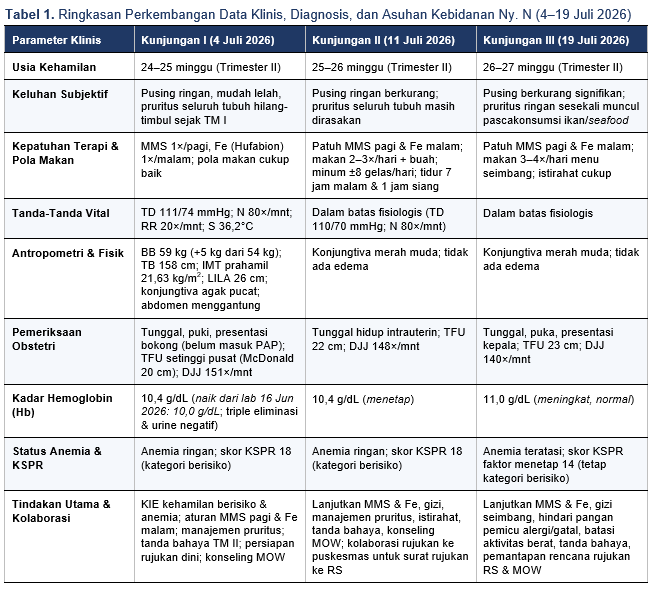
Clinical assessments showed good general maternal condition, vital signs within physiological limits, progressive increases in fundal height (20 cm, 22 cm, and 23 cm), and normal fetal heart rates (FHR) of 151 bpm at the first visit, 148 bpm at the second visit, and 140 bpm at the third visit. The initial midwifery diagnosis was established as G6P4A1 at 24–25 weeks of gestation, single live intrauterine fetus, high-risk pregnancy (Poedji Rochjati Score Card [KSPR] score of 18) with mild anemia accompanied by mild dizziness, fatigue, and pruritus. Management included care planning, clinical intervention (monitoring morning Multi-Micronutrient Supplement [MMS] and evening iron [Fe] tablet intake, alongside pruritus management), health education (iron- and vitamin C-rich nutrition, personal hygiene, second-trimester danger signs, birth preparedness, and counseling on permanent contraception/tubectomy [MOW]), collaboration for a planned early hospital referral, and periodic evaluation. By the third visit (July 19, 2026), the Hb level increased from 10.4 g/dL to 11.0 g/dL, indicating resolution of anemia; dizziness subsided, pruritus occurred only occasionally after consuming fish or seafood, and both maternal and fetal conditions remained stable.
Conclusions and Recommendations
Continuous midwifery care—combining MMS and iron supplementation, comprehensive health education, planned early referral collaboration, and periodic monitoring—successfully resolved mild anemia (Hb increased to 11.0 g/dL), alleviated clinical complaints, and maintained maternal and fetal stability throughout the monitoring period.
Contribution to Sustainable Development Goals (SDGs)
This case report contributes to achieving Sustainable Development Goal (SDG) 3 (Good Health and Well-being), specifically Target 3.1 (reducing the global maternal mortality ratio) and Target 3.2 (ending preventable deaths of newborns), through early risk detection, nutritional supplementation, and planned early referral in high-risk pregnancies. In addition, the provision of permanent contraception (MOW) counseling supports Target 3.7 (ensuring universal access to sexual and reproductive healthcare services, including family planning and health education).
Downloads
References
1. Riyanti N, Devita R, Wahyuni D. Analisis faktor yang berhubungan dengan risiko kehamilan pada ibu hamil. Jurnal 'Aisyiyah Medika. 2021;6(2). doi:10.36729/jam.v6i2.1051.Riyanti N, Devita R, Wahyuni D. Analisis faktor yang berhubungan dengan risiko kehamilan pada ibu hamil. Jurnal 'Aisyiyah Medika. 2021;6(2). doi:10.36729/jam.v6i2.1051.
2. Kementerian Kesehatan Republik Indonesia. Pedoman Pelayanan Antenatal Terpadu. Edisi ke-3. Jakarta: Direktorat Kesehatan Keluarga, Kementerian Kesehatan RI; 2020.
3. Rochjati P. Skrining Antenatal pada Ibu Hamil: Pengenalan Faktor Risiko, Deteksi Dini Ibu Hamil Risiko Tinggi. Edisi ke-2. Surabaya: Airlangga University Press; 2011.
4. Azizah R, Khairunnisa N, Fajriana E. Faktor-faktor yang berhubungan dengan resiko kehamilan. Journal of Language and Health. 2025;6(2):263–70. doi:10.37287/jlh.v6i2.6930.
5. World Health Organization. Guideline on haemoglobin cutoffs to define anaemia in individuals and populations. Geneva: World Health Organization; 2024.
6. Kementerian Kesehatan Republik Indonesia. Survei Kesehatan Indonesia (SKI) 2023 dalam Angka. Jakarta: Badan Kebijakan Pembangunan Kesehatan, Kementerian Kesehatan RI; 2023.
7. Aswanti, Lathifah N, Suhartati S, Dona S. Identifikasi komplikasi kehamilan dan persalinan di wilayah Puskesmas Tumbang Napoi. Health Research Journal of Indonesia (HRJI). 2025;4(2):97–103. doi:10.63004/hrji.v4i2.1020.
8. Thresiani M, Herdiningrat RS, Feriandi Y. Hubungan anemia pada ibu hamil dengan kejadian abortus di RSUD Karawang tahun 2021–2023. Bandung Conference Series: Medical Science. 2025;5(1). doi:10.29313/bcsms.v5i1.17342.
9. World Health Organization. WHO recommendations on antenatal care for a positive pregnancy experience. Nutritional interventions update: multiple micronutrient supplements during pregnancy. Geneva: World Health Organization; 2020.
10. Smith ER, Gomes F, Adu-Afarwuah S, Aguayo VM, Arifeen SE, Bhutta ZA, et al. Contribution of maternal adherence to the effect of multiple micronutrient supplementation during pregnancy: a systematic review and individual participant data meta-analysis. Advances in Nutrition. 2025;16(7):100455. doi:10.1016/j.advnut.2025.100455.
11. Kementerian Kesehatan Republik Indonesia. Peraturan Menteri Kesehatan Republik Indonesia Nomor 88 Tahun 2014 tentang Standar Tablet Tambah Darah bagi Wanita Usia Subur dan Ibu Hamil. Jakarta: Kementerian Kesehatan RI; 2014.
12. Ma'rifatun, Masrikhiyah R, Dewi YR. Hubungan pengetahuan, perilaku konsumsi tablet Fe dan asupan makan dengan kejadian anemia pada ibu hamil trimester III. Jurnal Ilmiah Gizi Kesehatan (JIGK). 2024;5(2):102–8.
13. Wijayanti E, Putri YK, Handayani TS. Hubungan pengetahuan dan sikap ibu tentang resiko tinggi kehamilan dengan kelengkapan antenatal care (ANC) di wilayah kerja Puskesmas Beringin Tiga tahun 2023. Journal of Midwifery. 2024;12(1):64–73. doi:10.37676/jm.v12i1.6194.
14. Battya AA, Lestari SH, Nengsih, Nurhaeni A. Peran kompetensi dan beban kerja bidan dalam optimalisasi deteksi dini kehamilan risiko tinggi di Praktik Mandiri Bidan. Jurnal Ilmiah Kebidanan Indonesia. 2026;16(1):29–34. doi:10.33221/jiki.v16i01.4677.
15. Arifah DF, Mudlikah S. Paritas dan usia ibu dengan anemia kehamilan di Puskesmas Nelayan Kabupaten Gresik. Jurnal Kebidanan. 2024;16(1):45–55.
16. Wisdayanti SR, Darmayani A. Suspek intrahepatic cholestasis of pregnancy tanpa pemeriksaan bile acid: tantangan diagnosis di fasilitas terbatas dan luaran janin. Glosains: Jurnal Sains Global Indonesia. 2026;7(1):199–208. doi:10.59784/glosains.v7i1.664.
17. Astuti RW, Ayub AD, Palola J, Rizal RV, Tedenki R, Oktarina T. Asuhan kebidanan pada ibu hamil trimester II dengan anemia ringan. Al-Su'aibah Midwifery Journal. 2025;3(2):245–8. doi:10.69597/amj.v3i2.47.
18. Meiriska IP, Anggraini D. Pendekatan laboratorium dalam identifikasi dini anemia pada ibu hamil. Journal of Public Health Science (JOPHS). 2025;2(2):144–52.
Downloads
Published
Data Availability Statement
Data available upon request to the corresponding author.
Issue
Section
Categories
License
Copyright (c) 2026 Aisya Nurtia Rahma Noviantika, Anis Nur Laili, Esyuananik Esyuananik, Deasy Irawati

This work is licensed under a Creative Commons Attribution-ShareAlike 4.0 International License.
This work is licensed under the Creative Commons Attribution-ShareAlike 4.0 International License, except where otherwise noted regarding intellectual property.