Effectiveness of a Deep Breathing Module on the Understanding of Non-Pharmacological Management Among Pregnant Women with Gestational Hypertension at Community Health Centers in Kendari City: A Preliminary Report
DOI:
https://doi.org/10.5281/zenodo.23570444Keywords:
Community health center, Deep breathing, Educational module, Gestational hypertension, Health literacyAbstract
Introduction and Methods
Hypertension in pregnancy is a major contributor to maternal morbidity. In line with the Sustainable Development Goals (SDGs) pillar regarding maternal health, non-pharmacological management such as deep breathing relaxation techniques serves as a complementary intervention that can be independently practiced by pregnant women. However, the success of this therapy relies heavily on the mother's level of understanding. This preliminary report aimed to evaluate the use of a deep breathing educational module on the understanding of non-pharmacological management among pregnant women with gestational hypertension at Community Health Centers (Puskesmas) in Kendari City. This preliminary study employed a pre-experimental, one-group pretest–posttest design. The sample consisted of 30 pregnant women with gestational hypertension within the working area of Community Health Centers in Kendari City. The research instrument was a comprehension questionnaire administered before (pretest) and after (posttest) the deep breathing module intervention. Data were analyzed descriptively to evaluate changes in mean scores and standard deviations.
Results
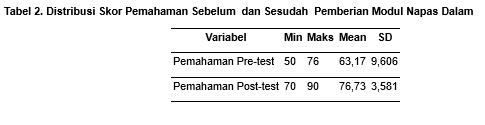
The respondent profile was dominated by women in the reproductive age group of 20–35 years (96.7%), in their second trimester of pregnancy (63.3%), and with multigravida parity status (63.3%). Measurement results demonstrated a substantial increase in the mean comprehension score from 63.17 at pretest to 76.73 at posttest. Furthermore, the decrease in standard deviation from 9.606 to 3.581 indicates that the use of the deep breathing module helped standardize the respondents' understanding of hypertension management.
Conclusions and Recommendation
The application of the deep breathing educational module improved and standardized pregnant women's understanding of independent hypertension management. Further inferential analysis and clinical studies involving a control group are required to confirm the statistical significance and effectiveness of these preliminary findings.
Contribution to Sustainable Development Goals (SDGs)
This study contributes to achieving Goal 3 of the Sustainable Development Goals (Good Health and Well-being), specifically Target 3.1, by supporting efforts to reduce maternal morbidity and mortality through improved health literacy in the independent management of gestational hypertension.
References
1. World Health Organization. Pre-eclampsia [Internet]. World Health Organization; 2025 [cited 2026 Feb 12]. Available from: https://www.who.int/news-room/fact-sheets/detail/pre-eclampsia
2. Socol FG, Bernad E, Craina M, Abu-Awwad SA, Bernad BC, Socol ID, et al. Health Impacts of Pre-eclampsia: A Comprehensive Analysis of Maternal and Neonatal Outcomes. Medicina (Mex). 2024 Sep;60(9):1486. doi:10.3390/medicina60091486
3. World Health Organization. WHO recommendations for prevention and treatment of pre-eclampsia and eclampsia. World Health Organization; 2011.
4. Kementerian Kesehatan. Pedoman Pelayanan Antenatal Terpadu. Edisi Ketiga. Kementerian Kesehatan; 2020.
5. Sharma DD, Chandresh NR, Javed A, Girgis P, Zeeshan M, Fatima SS, et al. The Management of Preeclampsia: A Comprehensive Review of Current Practices and Future Directions. Cureus. 16(1):e51512. doi:10.7759/cureus.51512 PubMed PMID: 38304688; PubMed Central PMCID: PMC10832549.
6. Aalami M, Jafarnejad F, ModarresGharavi M. The effects of progressive muscular relaxation and breathing control technique on blood pressure during pregnancy. Iran J Nurs Midwifery Res. 2016;21(3):331–6. doi:10.4103/1735-9066.180382 PubMed PMID: 27186213; PubMed Central PMCID: PMC4857670.
7. Moghaddam FG, Hoseinzadeh-Chahkandak F, Salmani F, Norozi E. Effect of educational intervention based on the theory of planned behavior (TPB) on amount of salt intake in pregnant women with PreHypertension. BMC Womens Health. 2024 Oct 4;24(1):548. doi:10.1186/s12905-024-03385-5
8. Gholami K, Norouzkhani N, Kargar M, Ghasemirad H, Ashtiani AJ, Kiani S, et al. Impact of Educational Interventions on Knowledge About Hypertensive Disorders of Pregnancy Among Pregnant Women: A Systematic Review. Front Cardiovasc Med. 2022 Jun 20;9. doi:10.3389/fcvm.2022.886679
9. Sheen JJ, Huang Y, Wright JD, Goffman D, D’Alton ME, Friedman AM. 318: Maternal age and preeclampsia outcomes. Am J Obstet Gynecol. 2019 Jan 1;220(1):S222–3. doi:10.1016/j.ajog.2018.11.339
10. Haavaldsen C, Thomas O, Eskild A. Risk of pre-eclampsia according to gestational age across three decades: population-based study. Ultrasound Obstet Gynecol. 2026;67(2):155–61. doi:10.1002/uog.70160
11. Kementerian Kesehatan. Pedoman Pelaksanaan Kelas Ibu Hamil. Kementerian Kesehatan; 2011.
12. Mustary M, Syafar M, Ansariadi, Riskiyani S, Moedjiono AI, Erika KA, et al. Health literacy and risk factors for preeclampsia: A case-control study in community health centers of Maros district, south Sulawesi. J Educ Health Promot. 2025 Jul;14(1). doi:10.4103/jehp.jehp_1741_24
13. Ravintaran T, Go KX, Che Isa IN, Mohd Norsuddin N, Sabarudin A, Mohamed Sharif N, et al. Effectiveness of an educational module in improving knowledge, awareness and perception among pregnant women regarding the safe use of prenatal ultrasound. Heliyon. 2022 Dec 30;9(1):e12773. doi:10.1016/j.heliyon.2022.e12773 PubMed PMID: 36685374; PubMed Central PMCID: PMC9850031.
14. Bundu SM, Amdadi ZA, Beddu S, Manjilala M, Lorica JD, Sabilah H. Effectiveness of the CAMPE module for preeclampsia prevention among high-risk pregnant women. J Kebidanan Dan Keperawatan Aisyiyah. 2025 Dec 26;21(2):110–9. doi:10.31101/jkk.4618
15. Garovic VD, Dechend R, Easterling T, Karumanchi SA, McMurtry Baird S, Magee LA, et al. Hypertension in Pregnancy: Diagnosis, Blood Pressure Goals, and Pharmacotherapy: A Scientific Statement From the American Heart Association. Hypertension. 2022 Feb;79(2):e21–41. doi:10.1161/HYP.0000000000000208
16. Yau KKY, Loke AY. Effects of diaphragmatic deep breathing exercises on prehypertensive or hypertensive adults: A literature review. Complement Ther Clin Pract. 2021 May 1;43:101315. doi:10.1016/j.ctcp.2021.101315
Downloads
Published
Data Availability Statement
Data available upon request.
Issue
Section
Categories
License
Copyright (c) 2026 Malahayati Nurdjaya, Fitriyanti Fitriyanti, Sitti Hadijah

This work is licensed under a Creative Commons Attribution-ShareAlike 4.0 International License.
This work is licensed under the Creative Commons Attribution-ShareAlike 4.0 International License, except where otherwise noted regarding intellectual property.