Capacity Building of Community Health Cadres by Health Survey Enumerators as an Opportunity to Accelerate Stunting Reduction and Control: A Policy Brief
DOI:
https://doi.org/10.5281/zenodo.23753395Keywords:
Anthropometry, Capacity building, Health survey enumerators, Policy brief, Posyandu cadres, StuntingAbstract
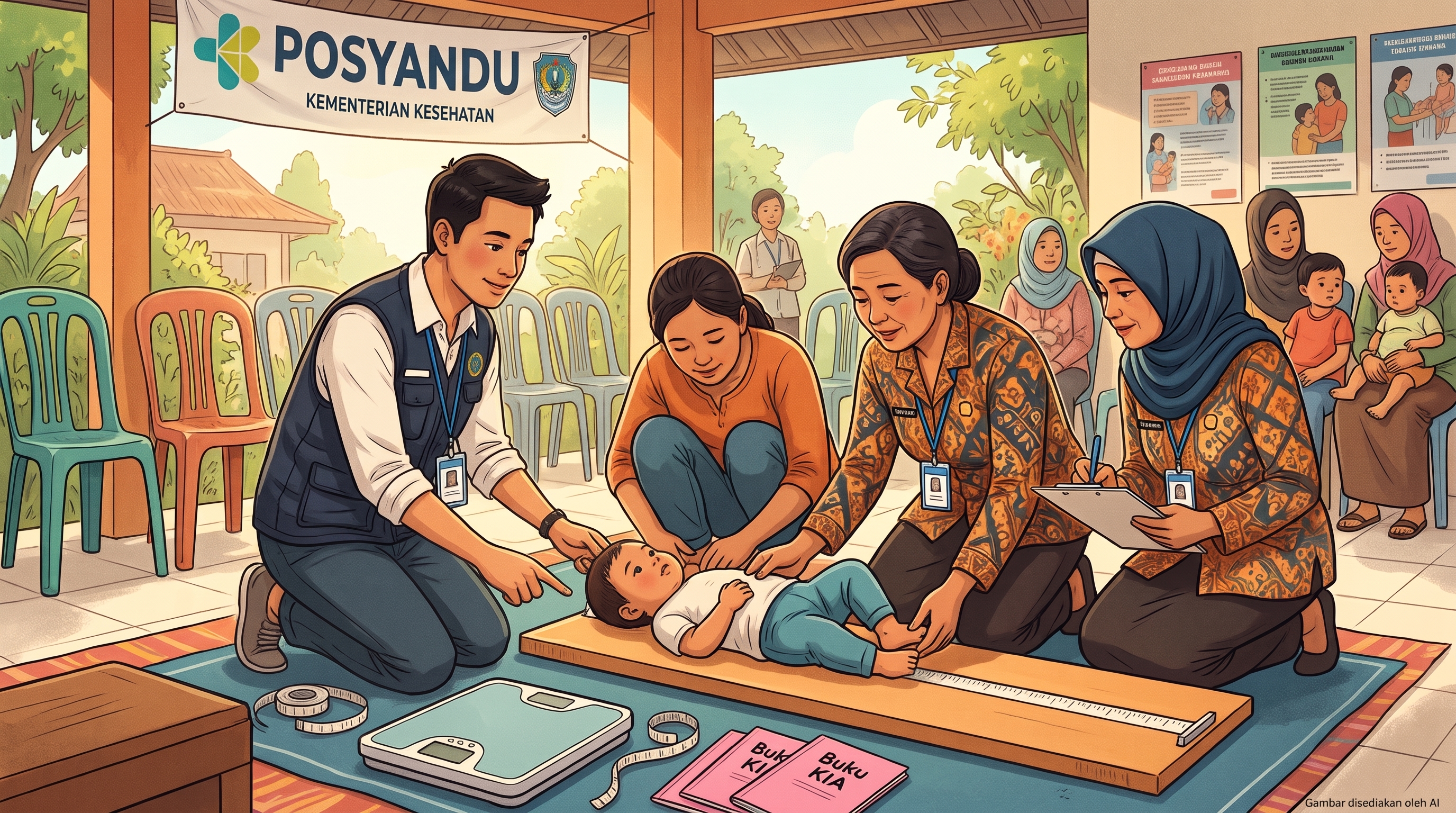
Nutritional fulfillment is a fundamental investment in human resource development that directly impacts the quality of national progress. Efforts to meet nutritional needs should not focus solely on adulthood, but must be optimized from the first thousand days of life, spanning the fetal, infant, and under-five periods. Inadequate nutritional intake during this golden period of growth has severe and irreversible consequences on child growth and development. In Indonesia, stunting prevalence was successfully reduced from 30.8% in 2018 to 21.6% in 2022, and accelerated efforts continue to be implemented to achieve the National Medium-Term Development Plan (RPJMN) target of 14%. Based on the findings of Focus Group Discussions (FGDs) with integrated health service post (Posyandu) cadres, it was identified that while the cadres had received training on the use of anthropometric equipment, the training was neither standardized nor certified, and periodic equipment calibration had not been conducted. Through mentoring and capacity-building activities, tangible improvements were observed in the cadres' procedural understanding and practical skills in measuring the body weight of children under five. Therefore, strategic planning is required at the local government and health department levels to enhance the precision and accuracy of child anthropometric measurements by strengthening the role of alumni enumerators from the Indonesian Nutritional Status Survey (SSGI) or Indonesian Health Survey (SKI) as technical mentors for Posyandu cadres. Furthermore, sustainable funding support is essential to underpin the implementation of stunting reduction policies in affected areas through cross-sectoral synergy and collaboration among local governments, health departments, and the Health Polytechnic of the Ministry of Health (Poltekkes Kemenkes) Jambi.
Contribution to Sustainable Development Goals (SDGs)
This policy brief contributes to achieving the Sustainable Development Goals (SDGs), specifically Goal 2 (Zero Hunger), Target 2.2 on ending all forms of malnutrition including stunting in children under five; Goal 3 (Good Health and Well-being) by strengthening the quality of primary healthcare services at Posyandu; and Goal 17 (Partnerships for the Goals) through multi-stakeholder collaboration among local governments, health departments, and higher health education institutions.
References
1. Kementerian Kesehatan. Buku Saku Hasil Studi Status Gizi Indonesia (SSGI) Tingkat Nasional, Provinsi, dan Kabupaten/Kota Tahun 2021. Kementerian Kesehatan; 2021.
2. Akseer N, Tasic H, Nnachebe Onah M, Wigle J, Rajakumar R, Sanchez-Hernandez D, et al. Economic costs of childhood stunting to the private sector in low- and middle-income countries. EClinicalMedicine. 2022 Mar 15;45:101320. doi:10.1016/j.eclinm.2022.101320 PubMed PMID: 35308896; PubMed Central PMCID: PMC8927824.
3. De Sanctis V, Soliman A, Alaaraj N, Ahmed S, Alyafei F, Hamed N. Early and Long-term Consequences of Nutritional Stunting: From Childhood to Adulthood. Acta Bio-Medica Atenei Parm. 2021 Feb 16;92(1):e2021168. doi:10.23750/abm.v92i1.11346 PubMed PMID: 33682846; PubMed Central PMCID: PMC7975963.
4. Badan Kebijakan Pembangunan Kesehatan. Survei Kesehatan Indonesia (SKI) 2023 Dalam Angka. Kementerian Kesehatan; 2023.
5. Beal T, Tumilowicz A, Sutrisna A, Izwardy D, Neufeld LM. A review of child stunting determinants in INDONESIA. Matern Child Nutr. 2018 Oct;14(4):e12617. doi:10.1111/mcn.12617
6. Laksono AD, Wulandari RD, Amaliah N, Wisnuwardani RW. Stunting among children under two years in Indonesia: Does maternal education matter? Sato MO, editor. PLOS ONE. 2022 Jul 25;17(7):e0271509. doi:10.1371/journal.pone.0271509
7. Farisita DH. Nutrition Interventions for Improving Nutritional Status of Toddlers in Cirebon Regency Indonesia. Indian J Public Health Res Dev. 2021. doi:10.37506/ijphrd.v12i3.16083
8. Hara MK, Adhi KT, Pangkahila A. Pengetahuan Kader dan Perilaku Asupan Nutrisi Berhubungan dengan Perubahan Status Gizi Balita, Puskesmas Kawangu, Sumba Timur. Public Health Prev Med Arch. 2014 Jul 1;2(1):33–8. doi:10.15562/phpma.v2i1.120
9. Darmiyanti NMD, Adiputri NWA. Efektivitas pelatihan kerja terhadap kinerja kader Posyandu. J Kebidanan. 2020 Aug 31;9(2):95. doi:10.26714/jk.9.2.2020.95-102
10. Peraturan Presiden. Peraturan Presiden Nomor 72 Tahun 2021 tentang Percepatan Penurunan Stunting. PP. 2021.
11. Peraturan Menteri Kesehatan. Peraturan Menteri Kesehatan Nomor 2 Tahun 2020 tentang Standar Antropometri Anak. Permenkes. 2020.
Downloads
Published
Data Availability Statement
Data available upon corresponding to the author.
Issue
Section
Categories
License
Copyright (c) 2026 Egy Sunanda Putra, Bambang Setiaji, Rusmimpong Rusmimpong, Syafrizal Syafrizal, Yosi Rulianto, Fery Sihotang, Animinarni Animinarni, Desif Upix Usmaningrum, Nirmala Ahmad Ma’ruf, Nurul Puspa Sari

This work is licensed under a Creative Commons Attribution-ShareAlike 4.0 International License.
This work is licensed under the Creative Commons Attribution-ShareAlike 4.0 International License, except where otherwise noted regarding intellectual property.