
[Update] High-Risk Sexual Intercourse Frequency in Pregnant Women Increases the Risk of Spontaneous Abortion: An Observational Study
DOI:
https://doi.org/10.5281/zenodo.23890713Keywords:
High-risk sexual intercourse frequency, Pregnant women, Risk of spontaneous abortionAbstract
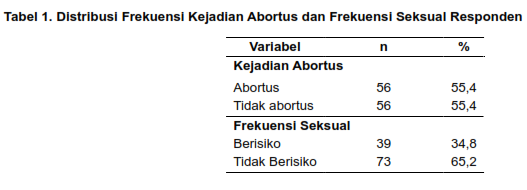
(In the initially published version, there were errors in the reported study period and the number of respondents presented in Table 1. The authors acknowledged these errors following feedback from the peer reviewers and have made the necessary corrections as presented in this updated version.)
Introduction and Methods
Spontaneous abortion, defined as fetal loss at a gestational age of less than 20 weeks, remains a major concern in maternal health. Several predisposing factors, including maternal, fetal, and external factors, can increase the risk of spontaneous abortion. One factor that remains under-researched in Indonesia is the relationship regarding sexual intercourse frequency during pregnancy. This study aimed to determine the relationship between sexual intercourse frequency in pregnant women and the occurrence of spontaneous abortion. This observational study was conducted at Kardinah Regional General Hospital (RSUD Kardinah) in Tegal City from November 2019 to July 2020 using a case–control design. A total sample of 112 respondents, consisting of 56 women who experienced spontaneous abortion (cases) and 56 women who did not experience spontaneous abortion (controls), was selected using a proportional sampling method. Data were collected through structured questionnaires and medical records. Sexual intercourse frequency was categorized as high-risk (≥1 time per week) and low-risk (<1 time per week or ≥1–3 times per month). Data analysis was performed using the Chi-square test and Odds Ratio (OR) at a significance level of p < 0.05.
Results
The results showed that 55.4% of respondents experienced spontaneous abortion, and 34.8% had a high-risk sexual intercourse frequency. The Chi-square test demonstrated a significant relationship between high-risk sexual intercourse frequency and the occurrence of spontaneous abortion (p = 0.000). Pregnant women with a high-risk sexual intercourse frequency were 11.96 times more likely to experience spontaneous abortion compared to those with a low-risk frequency (OR = 11.96; 95% CI = 4.397–32.509).
Conclusions and Recommendations
High-risk sexual intercourse frequency is significantly associated with the occurrence of spontaneous abortion. Engaging in high-risk sexual intercourse frequency can increase the likelihood of spontaneous abortion by 11.96 times compared to low-risk sexual intercourse frequency. Further research is required to examine the predisposing factors of spontaneous abortion alongside maternal sexual intercourse frequency. Health education in antenatal care services should consider incorporating topics related to sexual activity during pregnancy.
Downloads
References
1. World Health Organization. Abortion [Internet]. 2024 [cited 2025 Jan 19]. Available from: https://www.who.int/news-room/fact-sheets/detail/abortion
2. Aprianto I, Nulanda M, Wahyu S, Mappaware NA, Julyani S. Karakteristik Faktor Resiko Kejadian Abortus di RSIA Sitti Khadijah 1 Makassar. Fakumi Med J J Mhs Kedokt. 2022 Jul 31;2(7):481–8.
3. Janssen LE, Verduin RJT, de Groot CJM, Oudijk MA, de Boer MA. Sexual intercourse during pregnancy and its association with spontaneous preterm birth. Sex Reprod Healthc. 2023 Jun 1;36:100849.
4. Xu Q, Chan Y, Feng Y, Zhu B, Yang B, Zhu S, et al. Factors associated with fetal karyotype in spontaneous abortion: a case-case study. BMC Pregnancy Childbirth. 2022 Apr 14;22:320.
5. Oliveira MTS, Oliveira CNT, Marques LM, Souza CL, Oliveira MV. Factors associated with spontaneous abortion: a systematic review. Rev Bras Saúde Materno Infant. 2020 Aug 5;20:361–72.
6. Brustman LE, Raptoulis M, Langer O, Anyaegbunam A, Merkatz IR. Changes in the pattern of uterine contractility in relationship to coitus during pregnancies at low and high risk for preterm labor. Obstet Gynecol. 1989 Feb;73(2):166–8.
7. Goodlin RC, Schmidt W, Creevy DC. Uterine tension and fetal heart rate during maternal orgasm. Obstet Gynecol. 1972 Jan;39(1):125–7.
8. Yo Y, Kawasaki K, Moriuchi K, Shiro R, Shimaoka M, Matsumura N. The Effect of Sexual Intercourse during Pregnancy on Preterm Birth: Prospective Single-Center Cohort Study in Japan. Healthcare. 2023 Jan;11(11):1657.
9. Purisch S, Brandt J, Srinivas S, Bastek J. Is frequency of sexual intercourse during pregnancy associated with preterm birth? Am J Obstet Gynecol. 2014;210(January):S403.
10. Blumenstock SM, Barber JS. Sexual Intercourse Frequency During Pregnancy: Weekly Surveys Among 237 Young Women From A Random Population-Based Sample. J Sex Med. 2022 Oct;19(10):1524–35.
11. Kementerian Kesehatan. Pedoman Pelayanan Antenatal Terpadu. Kementerian Kesehatan; 2015.
12. Karimi A, Sayehmiri K, Vaismoradi M, Dianatinasab M, Daliri S. Vaginal bleeding in pregnancy and adverse clinical outcomes: a systematic review and meta-analysis. J Obstet Gynaecol. 2024 Dec 31;44(1):2288224.
Downloads
Published
Versions
- 2025-01-19 (2)
- 2024-12-20 (1)
Issue
Section
Categories
License
Copyright (c) 2024 Nasrawati Nasrawati, Hendra Yulita, Sitti Aisa

This work is licensed under a Creative Commons Attribution-NonCommercial-ShareAlike 4.0 International License.
This work is licensed under the Creative Commons Attribution-ShareAlike 4.0 International License, except where otherwise noted regarding intellectual property.